

Inverters are a key electrical component in modern campers: they give you household AC power (230V in Europe, 120V in the US, just like at home!) wherever you are.
In this article we’ll see in detail what inverters are, how they work, the best models on the market, which one to choose based on your needs and of course, how to install it correctly in your camper’s electrical system!
Let’s get started! 🙂
Table of Contents
2. What Types of Inverters Are There and Which One Should You Choose?
3. When Do You Need an Inverter (and When Don’t You)?
4. How to Choose the Right Inverter for You + Power Calculation Table!
5. The Best 12/24V Inverters for Value for Money – Our Opinion
7. How to Install an Inverter in Your Camper (WIRING DIAGRAM and PROTECTIONS!)
THE INVERTER IN YOUR CAMPER
Everything You Need to Know to Choose and Install
the Right One for Your Needs!
1. What Is an Inverter?

An Inverter is an electrical device that converts 12V (or 24V) direct current into alternating current (230V or 120V).
In less technical words: it takes the energy stored in your camper’s batteries (which run at 12V) and turns it into AC power, exactly the same kind of power you get from the sockets at home!
So, thanks to an inverter, you can use AC appliances in your camper (without having to be plugged into a hook-up!), for example: laptops, coffee machines, phone chargers, hair dryers, epilators, toasters, hair straighteners, camera chargers, TVs, blenders, vacuum cleaners etc.
2. What Types of Inverters Are There
and Which One Should You Choose?
Not all inverters on the market are the same, and not all of them are suitable for a camper installation.
In fact, if you’ve already had a look at the inverters out there (if you haven’t, don’t worry, we’ll do it together!), you’ll have noticed that there are three types: square wave, modified sine wave and pure sine wave.

SQUARE WAVE INVERTERS: DANGEROUS, AVOID THEM!
Square wave inverters produce a very “rough” current wave, only good for running a handful of simple work tools and basic lighting.
They’re extremely noisy, dangerous and unsuitable for powering any proper electrical appliance (plug a laptop, a toaster or a blender into a square wave inverter and you’d fry it in no time!).
That’s why, even though square wave inverters are cheap, they’re absolutely to be avoided!
MODIFIED SINE WAVE INVERTERS: AVOID!
Modified sine wave inverters, as you can see in the image above, produce a wave that tries to replicate a pure sine wave. It sits somewhere in between the square (rough) wave and the pure sine wave.
This type of inverter can power fairly simple AC appliances, such as water pumps (which you don’t need in a camper anyway, since they all run on 12V) and some phone chargers.
That said, plug a laptop, a tablet or a blender into one of these too, and they’d come out nicely toasted!
That’s why, even though modified sine wave inverters cost less than pure sine wave ones, these too are absolutely to be avoided if you care about your devices!
PURE SINE WAVE INVERTERS: THE ONLY ONES SUITABLE FOR A CAMPER!
And here we are at the only type of inverter that’s safe and useful to install in a camper: the pure sine wave inverter.
These inverters produce a pure wave (just like your sockets at home!), suitable for powering every appliance you normally use at home (laptops, PCs, TVs, hair dryers, hair straighteners etc.).
In short, these are the ONLY inverters worth considering, and from now on, whenever we say “inverter”, we’ll only be talking about this “pure sine wave” type.
3. When Do You Need
an Inverter (and When Don’t You)?

WHEN DO YOU NEED AN INVERTER?
You need an inverter in your camper’s electrical system if you want to use any appliance that runs on AC power (basically every appliance you’d normally plug into a socket at home).
Examples of AC appliances that need an Inverter:
- Laptop Charger
- Camera/Drone Charger
- Smartphone Charger
- Desktop PC
- Regular AC TV (like the one at home!)
- Hair Dryer
- Hair Straightener
- Blender
- Electric Kettle
- Induction or Electric Hob
- Thermoelectric Cooler
- Epilator
- Electric Oven
- Microwave
- Consoles like PlayStation/Xbox
- AC Air Conditioner
- etc.
An inverter is usually useful if you plan to spend most of your time off-grid, if you want electrical independence away from hook-ups, or if you’re planning camper trips that go beyond a simple weekend away.
WHEN DON’T YOU NEED AN INVERTER?
If your power consumption is very low, you only use your camper for short trips and/or you prefer staying at campsites or organized camper stops, you probably won’t need an inverter.
To do without one, all you need to do is “make do” with 12V appliances designed specifically for campers, which run directly off your 12V batteries.
Luckily, there are loads of 12V appliances for campers, and here are the most common ones:
- LED Lights
- LED Strips
- Water Pump
- Roof Fan (like the Maxxfan)
- Bathroom Extractors and Fans
- 12V Compressor Fridges
- 12V Air/Water Heaters
- 12V Camper TVs
- Antennas
- Radio
- USB Sockets
- 12V Air Conditioners
- 12V Heated Blankets
- etc.
Of course, not having an inverter in your camper doesn’t mean you’ll “never, ever” have AC power: it just means you’ll only have it when you’re plugged into a hook-up (as a direct supply).
4. How to Choose the Right Inverter for You
+ Power Calculation Table!

WHY DOES YOUR INVERTER NEED TO BE THE RIGHT SIZE?
Before looking at the best inverter brands (we’ll get there in a moment!), it’s important to understand how powerful an inverter you actually need!
If you fit an inverter that’s too small (for example a 100W one to power a 200W computer), the moment you plug your appliance in, the inverter will go into protection mode and shut itself off.
At the same time, fitting a heavily oversized inverter isn’t a good idea either: an inverter draws power even with nothing plugged in, and the bigger it is, the more it draws (a big 3000W inverter can easily use 1-2Ah every hour just by being switched on, while a 200W one uses almost nothing :)).
Choosing an inverter sized for your needs is therefore the best choice to power your devices without wasting energy (which, as you well know, is always precious in a camper or any mobile home!).
HOW TO CHOOSE THE RIGHT POWER FOR YOU!
PRACTICAL EXAMPLE:
- A 100W inverter can power a 60W laptop, but not two laptops at the same time (60W+60W=120W).
- A 200W inverter can power two 60W laptops at the same time, but not a 400W blender.
- A 1500W inverter can power a 1200W hair dryer and two 60W laptops at the same time etc.
To work out the right inverter for your needs, the most important thing is to write down exactly what you’ll be powering with it: Laptop? TV? Blender? Induction hob?
Once you have your list, add up all the wattages (you’ll find how many watts each one uses in its spec sheet or on its charger), and you’ll know how powerful an inverter you need to run them all at the same time!
If you’re happy using them one at a time instead, choose an inverter powerful enough to run your most power-hungry appliance 🙂
DOWNLOAD THE AUTOMATIC TABLE TO SIZE YOUR INVERTER AND BATTERIES

To help you choose and avoid mistakes, I created an Excel Table where you can enter your appliances (both 12V and AC) and the hours you expect to use them each day, and the table will automatically calculate the inverter power you need (and even the battery bank needed to support it!).
You can download the Excel Table for Automatic Battery and Inverter Sizing from the button below!
Inside the file you’ll find simple instructions on how to use the table correctly!
Once you’ve worked out the right inverter power for you, let’s move on to the best inverter brands and the ones I personally suggest you consider 🙂
5. The Best 12V Inverters for Value for Money:
Our Opinion
After a lot of comparing and analysing, I decided to put together a list of the best value-for-money 12V inverters (ideal for campers!) currently on the market, to help you choose!
These are the best inverters for a camper or converted van.
If you’re looking for an inverter for a boat or a truck running on 24V batteries, good to know: all the following inverter brands also make 24V versions 🙂
1. GIANDEL INVERTER
THE BEST VALUE-FOR-MONEY CHOICE!
Giandel Inverters are great products: solid, reliable and high-performing at a great price (much cheaper than many better-known brands!).
We have a Giandel 3000W installed in our Van, and these are the same inverters I recommend in my camper electrical system consultations.
Tested for years, it has never given us a single problem. Customer service is impeccable, and the inverters come with a remote switch, mounting kit, LED display and fast-charging USB ports included.
See All Models and Prices:

2. VICTRON INVERTER
TOP OF THE RANGE FOR THOSE WITH MONEY TO SPEND (THEY’RE PRICEY!)
I’ve never made a secret of the fact that I absolutely love Victron, in all my articles on camper electrical systems!
After all, Victron is synonymous with top quality: smart, long-lasting products you can monitor via Bluetooth, configurable, customizable, interconnected… the list goes on!
Victron inverters are, of course, top-of-the-range products too, and some are even hybrids with a built-in battery charger and solar MPPT.
The only reason I put them in second place is their high price (honestly way too high, in my opinion!), and the fact that monitoring an inverter via Bluetooth isn’t nearly as useful as it is for a charge controller or a battery smart shunt.
That said, their standby/eco function (they switch off when they don’t detect any load, using practically zero power) is really handy!
See All Models and Prices:

3. EDECOA INVERTER
THE BEST BUDGET INVERTER WITH A REMOTE SWITCH
Edecoa inverters are solid and of proven quality.
Like the Giandel, they have a remote switch to turn them on and off, and even to keep an eye (a very rough one!) on the battery voltage.
To keep the price down, these inverters don’t have an LED display (which can be useful to diagnose problems), but you can still control them through the ethernet cable.
They’re a middle ground between Giandel and Green Cell, which we’ll see in a moment. With Edecoa, be careful: they also sell lots of modified sine wave models (which aren’t suitable for a camper!), so make sure you don’t mix them up!
See All Models and Prices:

4. GREEN CELL INVERTER
THE BEST SMALL INVERTER TO SAVE MONEY!
Green Cell inverters are no-frills quality products: no Bluetooth, no remote control, no LED screen, no ethernet!
They simply do what they’re made for: turn your 12V energy into AC power!
Green Cell Inverters are the best option if you want to save as much as possible, without ending up with poor-quality, unsafe products.
Their quality is backed by the many positive reviews they’ve collected over time, on Amazon and elsewhere, and they also offer lots of small models!
See All Models and Prices:
6. Inverter Extras
Basically, all inverters do the same thing: they take the 12V energy from your batteries and turn it into AC power.
That said, besides the price and the quality of the manufacturer, some inverters come with “optional” features that might interest you, depending on your needs.
These include:
- Display/Remote Switch: A wired switch (via ethernet cable) to turn the inverter on and off more conveniently (ideal if you want to install the inverter in a locker you can’t easily reach)
- Bluetooth App: Typical of Victron Inverters and a few others, it lets you monitor the inverter from an app and see various stats (including real-time consumption, input voltage, output load etc.)
- Protections: “Optional” features that really shouldn’t be optional: protection against over-voltage, under-voltage, short circuit, overload and high temperature. All the inverter brands I’ve recommended so far already have these protections built in, and personally I’d never consider an inverter that’s missing any of them!
- Standby Function: When the inverter has no load connected, it switches itself off automatically after a few minutes, saving power. It’s handy for those times you forget the inverter on, but in my humble opinion it’s far from essential (when you’re not using the inverter, just remember to switch it off!).
7. How to Install an Inverter in Your Camper
(WIRING DIAGRAM and PROTECTIONS!)

Installing an inverter in a DIY camper is simple and something anyone can do.
That said, it’s important to have a clear idea of what you’re doing and to understand a few basic safety rules (remember: never mess around with electricity!).
INSTALLING THE INVERTER IN YOUR CAMPER’S ELECTRICAL SYSTEM – STEP BY STEP
1) Place the inverter close to the batteries/bus bars: the more powerful an inverter is, the more energy it draws, and the input current (measured in “amps”) is usually very high. The further it is from the batteries, the thicker (and by quite a bit!) your cables will need to be.
2) Connect the cables to the Leisure Battery: red to the positive and black to the negative, with the fuse on the positive cable (see point 6). Some high-power inverters come with several red and several black cables to be used in parallel (all the reds to the positive, all the blacks to the negative). Personally, I recommend replacing them with a single, thicker cable (see the dedicated article on How to Size Electrical Cables), so you can protect it properly with one fuse.
3) Connect the cables to the Inverter: connect the red cable (or cables, if there’s more than one) to the inverter’s positive terminal, and the black one to the negative. When you connect the second cable you’ll see a small spark: that’s completely normal (it’s the inverter’s capacitors charging) and does no harm 🙂
4) For Inverters of 1000W or more – Connect them to the Vehicle Chassis: inverters over 1000W usually have a ground terminal to connect to the vehicle chassis (to a bolt or screw touching bare, unpainted metal). This discharges the current in case of a fault (and could save you from a nasty shock!).
5) Plug in your AC Appliances and switch the Inverter on: now that the inverter is connected to the batteries, all that’s left to do is plug in the devices you want to power and switch the inverter on 🙂
6) (DON’T SKIP IT!) Fit a Fuse and an AC Circuit Breaker: modern inverters already have internal protections, but those protect the inverter, not the cable between it and the battery. A resettable fuse on the 12V positive cable, as close to the battery as possible, protects you from fires in case of a short circuit, and a circuit breaker (MCB) on the AC output cable (see image) gives you extra protection against current leaks.
HOW TO CHOOSE CABLES, FUSES AND CIRCUIT BREAKER
- CABLES: Consider the inverter’s power and its distance from the battery, then follow this table.
- FUSES: Divide the inverter’s power by 10 (e.g. 3000W/10 = 300A fuse) for a 12V system (halve it for 24V). Choose resettable fuses so you can easily disconnect the inverter whenever you need to.
8. Conclusion

And here we are at the end of today’s article! 🙂
In this article we’ve seen together what an inverter is, what types of inverters exist, how to choose the right one for YOUR needs and how to install it.
If you found the article useful, if you still have questions or doubts, or if you spotted a mistake in the article (it can always happen), let me know in the comments below! 🙂
Before you go, here’s a list of resources/guides that might come in handy if you’re building your van/camper’s electrical system or upgrading an existing one:
- PowerQueen LiFePO4 Batteries: Low Cost, Maximum Performance!
- The Complete Guide to a DIY Camper Electrical System – With Diagram
- Simplified Wiring Diagrams Ready to Install
- How to Choose 12V Cable Size – Complete Guide
- The Complete Van Conversion Library – All the Guides
- How to Convert a Van into a Camper – The Complete Guide
As always, thanks for reading,
and see you in the next article! 😀

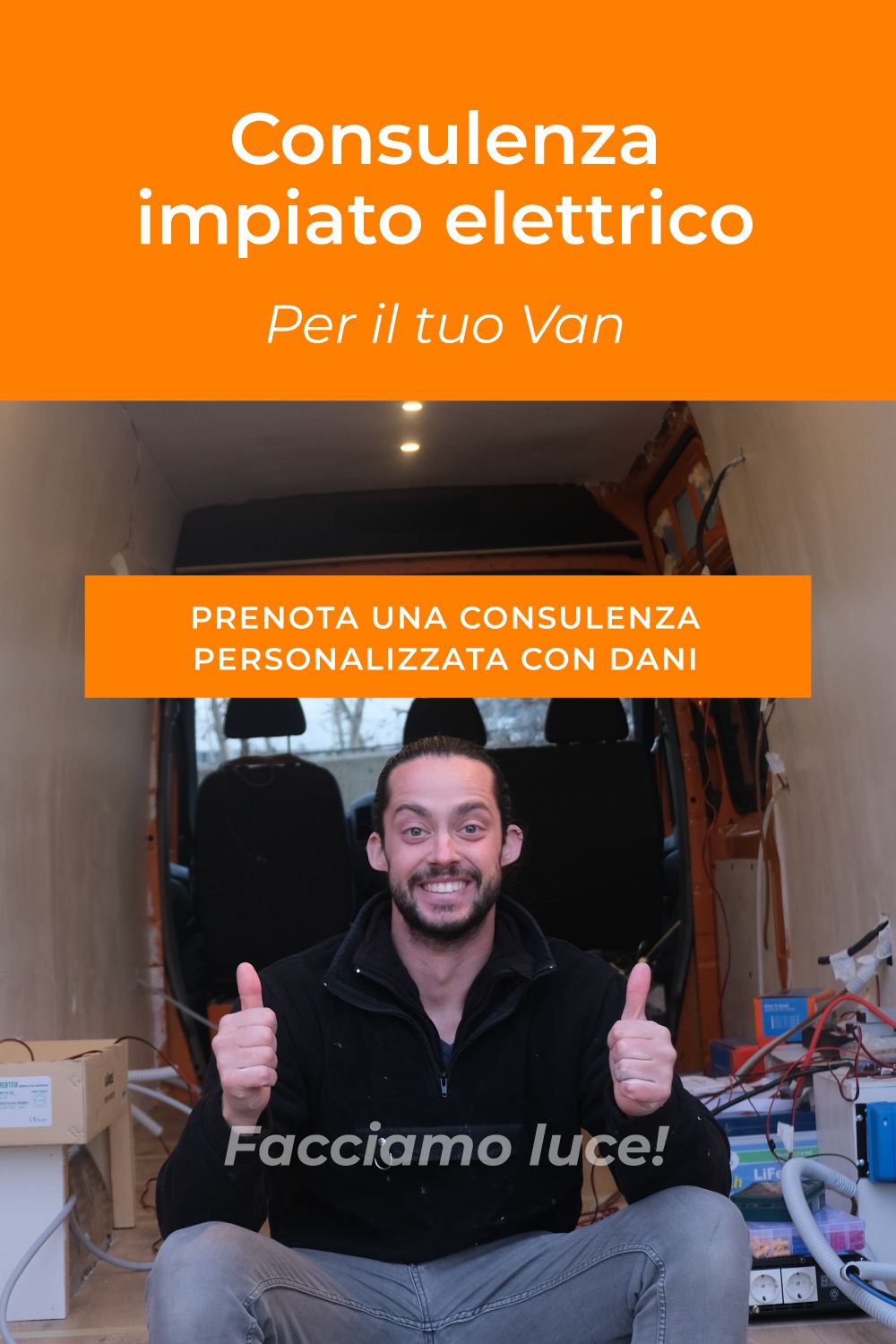
ARE YOU BUILDING OR UPGRADING YOUR CAMPER’S ELECTRICAL SYSTEM AND STILL DON’T FEEL CONFIDENT?
BOOK A CONSULTATION!
What’s in it for You?
- A consultation to design an Electrical System that meets YOUR energy needs.
- A wiring diagram of the Electrical System tailored to your needs
- Instructions on the order to install everything in, plus safety tips
- A list of the materials/accessories to buy, so you get the right stuff and don’t waste money on the wrong components
- All the sizes of Cables and Fuses to use
What’s in it for Me?
- A little money to support the blog’s costs and put fuel in Arancino, our van 🙂
- The Joy of having helped someone build their dream

Guarantee: 100% Satisfaction or Your Money Back!
With my consultation I aim to make the research and design of your electrical system as easy as possible, clear up all your doubts and help you through the DIY install. If my work isn’t as useful as you hoped, I offer a full refund, with no time limit and no questions asked 🙂
€145,00

5 Tips to Protect Your Financial Privacy When Traveling Abroad
Hello beautiful people, and welcome back on the route! 🙂 Have you ever thought about how many people know WHERE you are on a normal travel day? I was thinking about it the other day... and it is crazy! The airline has your itinerary. The hotel has your card number, a...

The 7 Best Things to Do in San Antonio Beyond the Alamo
Hello beautiful people, and welcome back on the route! 🙂 Ask anyone what to do in San Antonio and you'll get the same two answers: the Alamo and the River Walk XD Both are worth it, no doubt! But if you stop there, you will likely spend your trip in the same 2 square...

7 Unusual Things to Do in Hurghada (Beyond the Sunbed!)
Hello beautiful people, and welcome back on the route! 🙂 Tell a friend you're going to Hurghada and you'll probably get a little smile, as if you'd said "all-inclusive, pool bar, see you in a week". And sure...you can do just that! Nobody's judging ahah 😉 But let us...

Why Choose India for a Tiger Safari Tour?
Hello beautiful people, and welcome back once more on the route with us! 🙂 In this article we are going to talk about tigers, and how to maximize your chances to see them in real life! 🙂 First things first, if you dream of seeing a wild tiger out of the zoo, there is...

7 Best Custom Camper Van Builders in the USA (2026)
Most people who fall for vanlife start out planning to convert their own van themselves - (if you're thinking about it too, here are 10 things to know before you even start!). You know we did that too (it's 5 years by now, we are talking about van conversion DIY and...

7 Curious Moving Day Traditions From Around the World
Hello beautiful people, and welcome back on the route with us once more! 🙂 Today we are talking about something unusual: MOVING OUT! No matter where you live around the globe, moving house feels like the most universally boring chore on the planet! Said that, it is...

Hated Then, Loved Now: 7 Curiosities About Iconic Buildings
Did you know that the Eiffel Tower had a petition against it signed by some of the greatest writers in France? Or perhaps that George Orwell wished someone had blown up the Sagrada Familia? Or that a London skyscraper got a nickname so rude the papers barely printed...

Behind the Marble: 7 Fun Facts About Italy’s Greatest Landmarks
Hello beautiful people, and welcome back on the route! 🙂 Today we are going to talk about the most iconic Italian landmarks... "Agaaaaain?!!" you might be thinking - "everybody knows them already!". Yeah, it can be. Italian landmarks are famous worldwide and...

The Travel Lesson Vienna Taught Me About Choosing Accommodations
If Booking.com handed out awards for "overthinking hotel choices", I'm pretty sure I'd be a finalist. Seriously! I can't help spending days comparing hotels, reading reviews, zooming in on Google Maps, and convincing myself one place is dramatically better because it...

No More Digital Borders: How to Stay Connected in Any Country
Hello beautiful people, and welcome back on the route! 🙂 Today we are going to talk about INTERNET ACCESS, which for digital nomads like us, has today the same importance as our comfy beds, foods and passports! A bit sad to say perhaps, but today Internet has become...

Why Travel Wrecks Your Sleep—and How to Fix It
We have lost count of how many friends have told us before leaving for a holiday "I can't wait for this trip, I'm finally going to catch up on sleep." And every single time, we smile a little, because we already know how that usually goes! xD Unless you go to an...

17 Surprisingly Good Ways to Kill Time While Travelling
Let's be honest for a second: we're probably the first generation in history that almost never gets to experience real boredom. Nowadays eveyone of us can carry an entire library, a small army of teachers, every song we've ever loved and basically every person we...

The Best Yacht Brokers in Newport & New England (2026)
l Hello beautiful people, and welcome back on the route! 🙂 In this article, we will take a ride to Newport (in Rhode Island), which is the historic capital of American yachting! Home of the America's Cup legacy, the Newport International Boat Show, and the summer base...

7 Curious Fishing Traditions From Around the World
Hello beautiful people, and welcome back on the route once more! 🙂 Today, on our never-ending journey through the curiosities of this planet, we will dive into lakes and seas into discovering the strangest human traditions about fishing! And no...we are not referring...






0 Comments