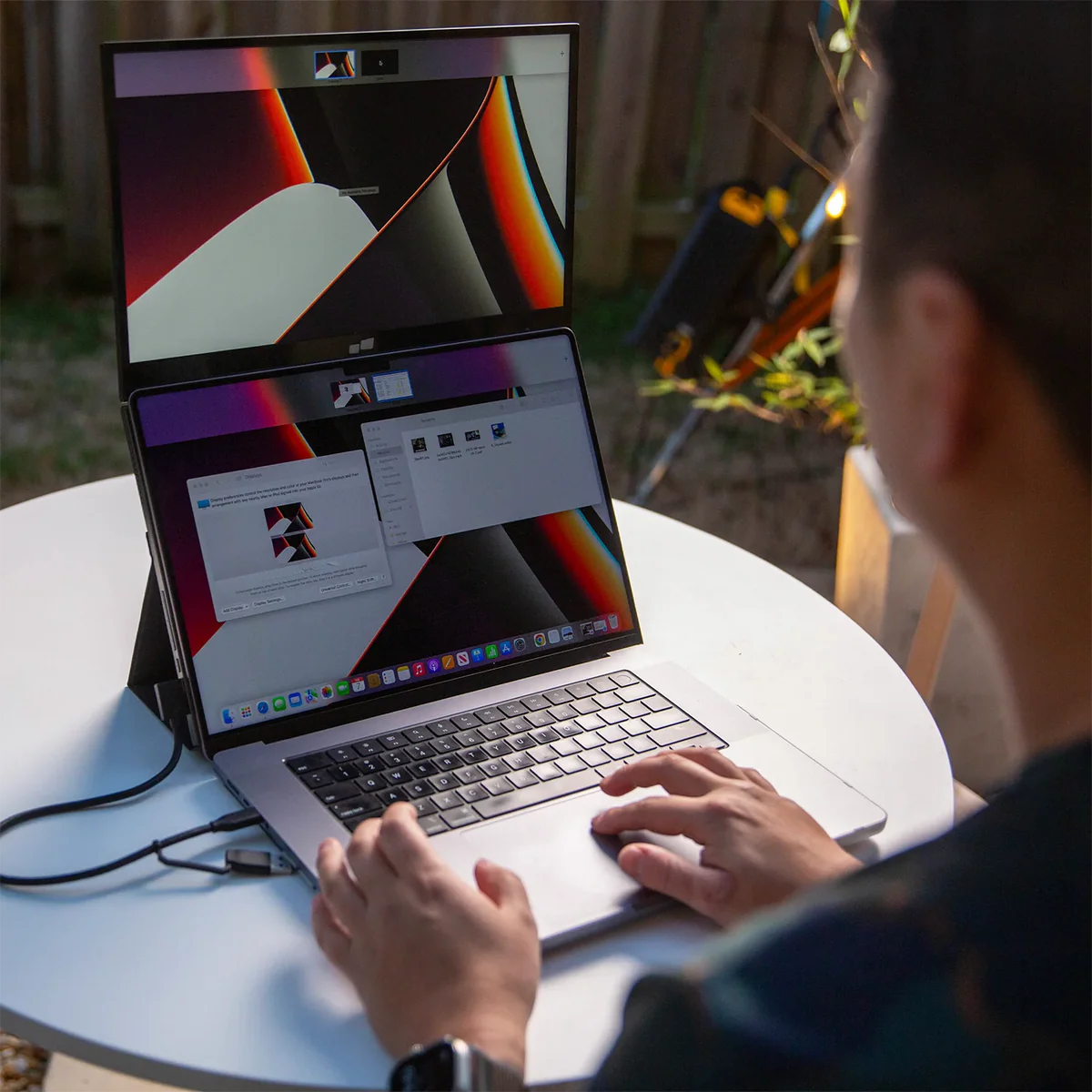
When I first heard about adding a second screen to my laptop, I was skeptical.
Would it really help?
Or was it just extra bulk I didn’t need—especially while working from a campervan, where as you know every little space and gram matter?
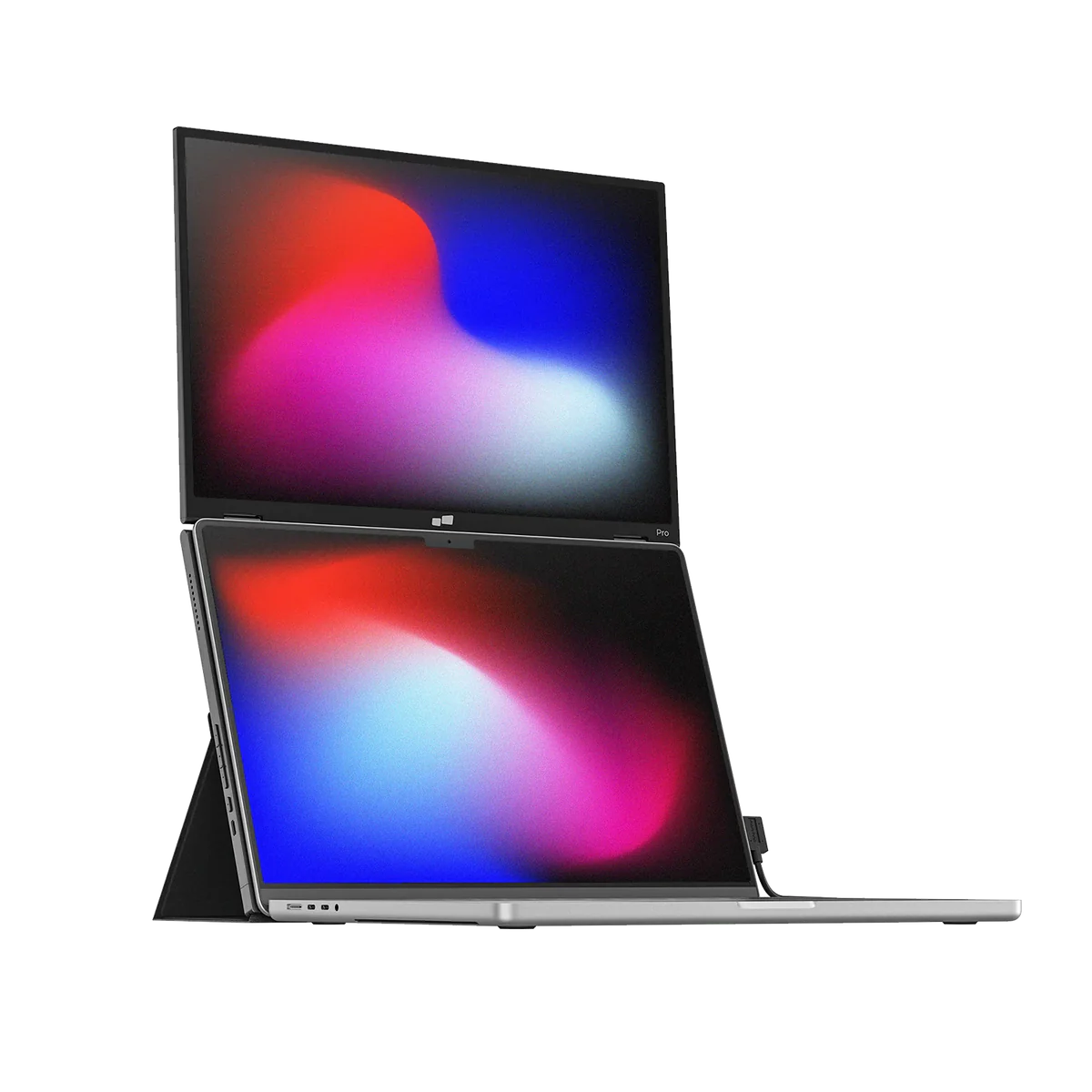
After testing the Extra Screen for Laptop Duex Max Float 2.0 extender from Mobile Pixels, I can confidently say: wow! Just WOW!
This little device completely transformed the way I work on the road: From editing videos and writing blog posts to managing emails and planning routes — it’s like my workflow finally clicked into place, and it didn’t make me miss my double-desktop studio!
Of course, just slapping on a second screen isn’t enough.
The real magic comes from learning how you use it—setting it up strategically and making it part of a streamlined system (yea…as you know I love having systems for everything eheh).
In this article, I’ll share 7 powerful reasons why I believe a dual-monitor setup deserves a spot in every digital nomad toolkit—and how it helped me get more done while living and working on the move.
Let’s dive right in! 🙂
7 Reasons why a Dual Screen
is an Awesome Hack for Boosting
Digital Nomad Productivity
1. You can Assign Zones for different Tasks

Having two screens, can help to mentally and visually divide your workspace into zones.
One screen becomes the “active work” zone—for writing, editing, coding, or designing—while the other acts as the “support zone” for communication, research, notes, or tracking tools.
I personally feel that this simple structure greatly helps you stay organized and reduces cognitive load.
With a double screen, I feel I always more intuitively know where to look for what, and the brain naturally adapts to the layout.
It’s like building a mini command center wherever you are on the road: campervan, bar, hostel postation or wherever!
Assigning zones also helps to resist the urge to constantly jump between unrelated tasks.
In conclusion, one of the main benefits of a Dual Screen is that it helps your workspace to becomes intentional—clean, functional, and focused on what matters!
2. Less clutter and Windows
on top of one another

Ever feel mentally exhausted after a work session—without even doing that much?
One hidden culprit is digital clutter.
Constantly stacking windows on top of each other, resizing tabs, or searching for that buried document creates invisible stress.
It’s a low-level chaos that adds up.
A dual-screen setup gives your brain room to breathe.
With more visual space, everything has its place: no need to juggle overlapping windows or fight with a crowded desktop. You see what you need, when you need it, without extra clicks or confusion.
This clarity reduces mental fatigue and decision overload—two silent productivity killers.
Especially for digital nomads who already juggle travel logistics, new environments, and shifting routines, cutting out digital noise can feel like a breath of fresh air.
Your mind stays calmer, your workspace stays cleaner, and your energy goes where it belongs: into your work.
3. Keep your Videoediting Program Open
while looking for Clips and Music

If you do any kind of video editing on the road—whether for YouTube, social media, or client work—you know the frustration of bouncing between your editing timeline and folders full of raw footage, music tracks, or B-roll libraries.
With a dual-screen setup, that friction disappears.
You can keep your video editing software (like Premiere Pro, Final Cut, or DaVinci Resolve) open on one screen while using the other to browse external drives, download assets, or preview audio clips.
No more minimizing windows or losing your place on the timeline.
Everything stays in view, everything flows.
It’s a smoother, faster editing experience that helps you stay creative instead of getting bogged down in file management.
Especially when you’re working from a van or small mobile studio, this setup turns tight spaces into efficient production zones.
4. A Dual Screen allows me to write blog posts
while doing research at the same time
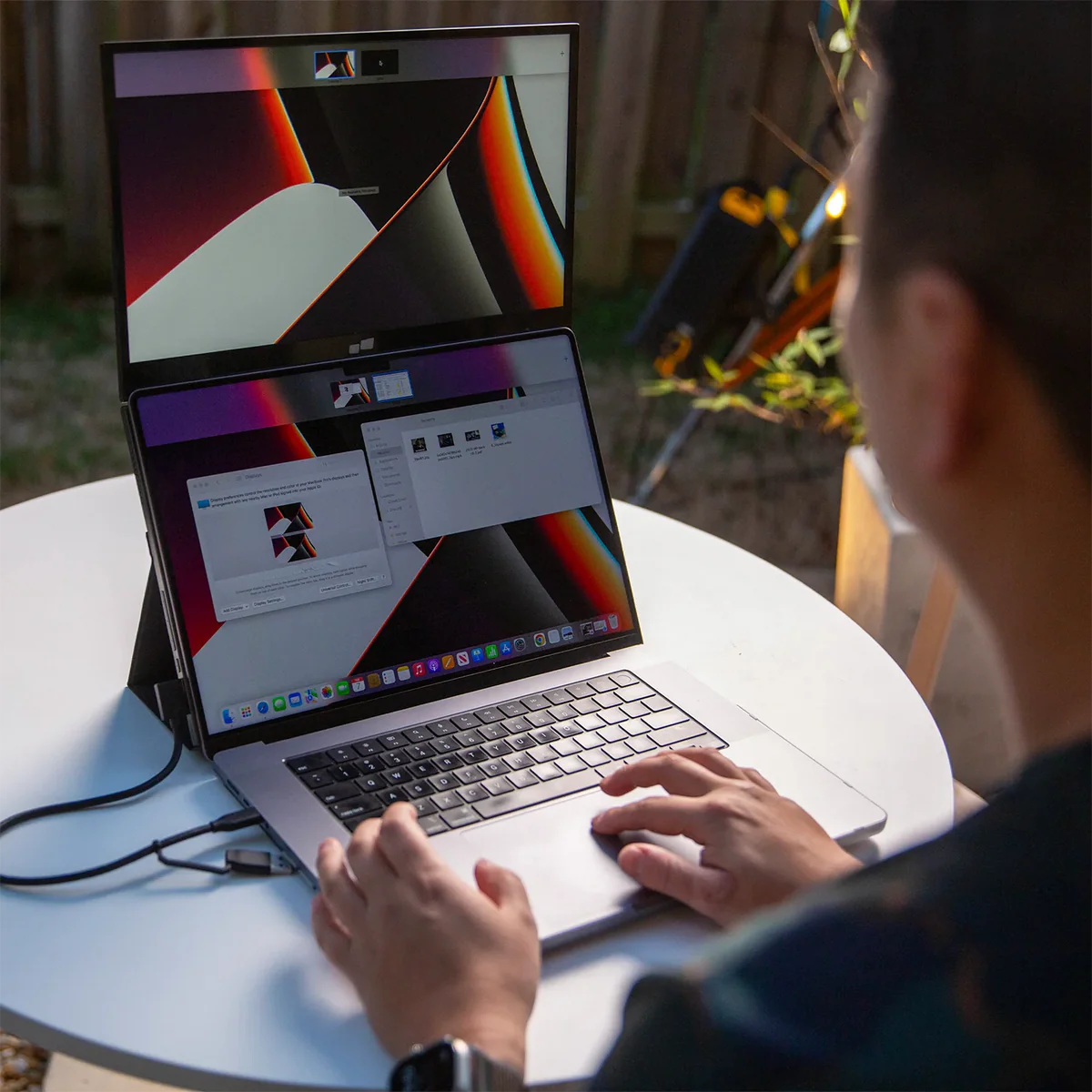
As a digital nomad, writing blog posts often means juggling tabs (here we go again!): one for research, one for writing, and probably a few more for inspiration or stats.
It’s easy to lose focus—or worse, lose your hype entirely!
With a dual-screen setup, you can write on one screen and keep your research open on the other. No more jumping back and forth or trying to split a tiny laptop screen into awkward halves.
I feel this setup keeps your flow uninterrupted.
You can fact-check, quote, or grab ideas on the fly while your blog post stays front and center.
The result? Faster writing, fewer distractions, and a smoother creative process wherever you are!
5. Keep an AI-Screen always with you,
while doing Daily Taks
6. Take better notes and consult documents,
while Communicating with Others!

Ever been on a video call where someone asks you to check a file, take notes, or share details—only to realize you have to minimize everything just to find it?
That constant toggling is distracting and inefficient.
With a dual-screen setup, you can keep your call or chat open on one screen while actively taking notes or referencing documents on the other.
Whether you’re in a client meeting, remote team check-in, or collaborating on a project, it helps you stay engaged without missing a beat. When I do consulting services, I always have my notes and maybe even ChatGPT open to stay engaged with my clients while still searching for information and taking notes without distractions.
In few words, a Dual Screen has also the potential to make you look more professional, respond faster, and avoid the classic “Wait, let me find that…” moment.
It’s especially powerful for digital nomads who rely on clear, organized communication—no matter where they are in the world.
7. Create Boundaries Between Work and Leisure
(Even in a Tiny Space)

When you live and work in the same space—whether it’s a campervan, Airbnb, or tiny apartment—it’s easy for your work and personal life to blur together.
That mental mix-up leads to burnout, procrastination, or both.
A dual-screen setup can surprisingly help you draw clearer boundaries.
Use one screen strictly for work-related tasks—emails, editing, writing, meetings.
Use the second for leisure or light tasks: a YouTube video playing softly in the background, a to-do list, or even your meditation app.
By assigning roles to each screen, you create a psychological separation of spaces—even if your physical space is limited.
It’s a subtle trick, but it trains your brain to shift gears more smoothly, helping you stay focused when it’s time to work and relaxed when it’s time to unplug.
Conclusions 🙂
And here we are at the end of our little productivity journey from the road! 😀
In this article, I shared with you 7 benefits I personally discovered while using a dual-screen setup—especially the Duex Max DS by Mobile Pixels—during my travels and work sessions from the campervan.
From reducing mental fatigue and boosting focus, to making video editing, writing, and communication smoother, a second screen has truly changed the way I work while moving.
What once felt like a bulky extra now feels like an essential tool in my digital nomad kit.
So if you’re serious about working smarter (not just harder) while chasing freedom on the road, I genuinely recommend giving this setup a try. It might just become your new favorite travel companion.
Said this… we’ve reached the end, but before you go:
👉 Have you ever tried working with a dual-screen setup?
👉 Do you have a favorite productivity hack for digital nomads?
Let’s chat in the comments—I’m always on the lookout for new ways to upgrade the mobile workstation! 😄
Hereafter, I will leave you a few articles that you might also be interested in checking out:
Thank you for reading, and see you in the next article!

Mount Toubkal in 2 Days or 4? How to Choose the Right Trek for You
Hello beautiful people, and welcome back on the route with us, today once more in Morocco! 🙂 Did you know that just 65 km south of Marrakesh, behind the palm trees and the gorgeous chaos of the medina, there is a mountain that reaches 4,167 metres?! That is Jebel...

Trevi Fountain: History, the Coin Toss, the €2 Ticket and the Best Time to Visit
Photo: Photographer in RomeWritten by Julia, who runs the studio Photographer in Rome, a team that organizes and conducts photoshoots for couples and engagement sessions in Rome. Julia has been working professionally in this field since 2019. Every visit to...

Agafay or Merzouga? Which Moroccan Desert Is Worth Your Time
Spend more than a couple of days in Marrakesh, and sooner or later someone will ask you the magic question: "Desert tour, my friend?" 😄 The riad owner, the guy at the spice stall, the taxi driver... everybody seems to have a cousin with a camp! The thing that...

7 Smart Ways to Save on Fuel with your Campervan
Hello beautiful people, and welcome back on the route! 🙂 We are finally on the way back from our trip through Norway and Sweden, Finland and the Baltic countries...and wow, it has been an incredible journey! In a separate article, we will be talking about our...


0 Comments